Sense & compare
Normalize observations. Preserve evidence. Understand what changed in the genome.
A continuously learning cyber-resilience organism
Understand your connections. Recognise dangerous change. Remember what worked. Become more resilient with every verified outcome.
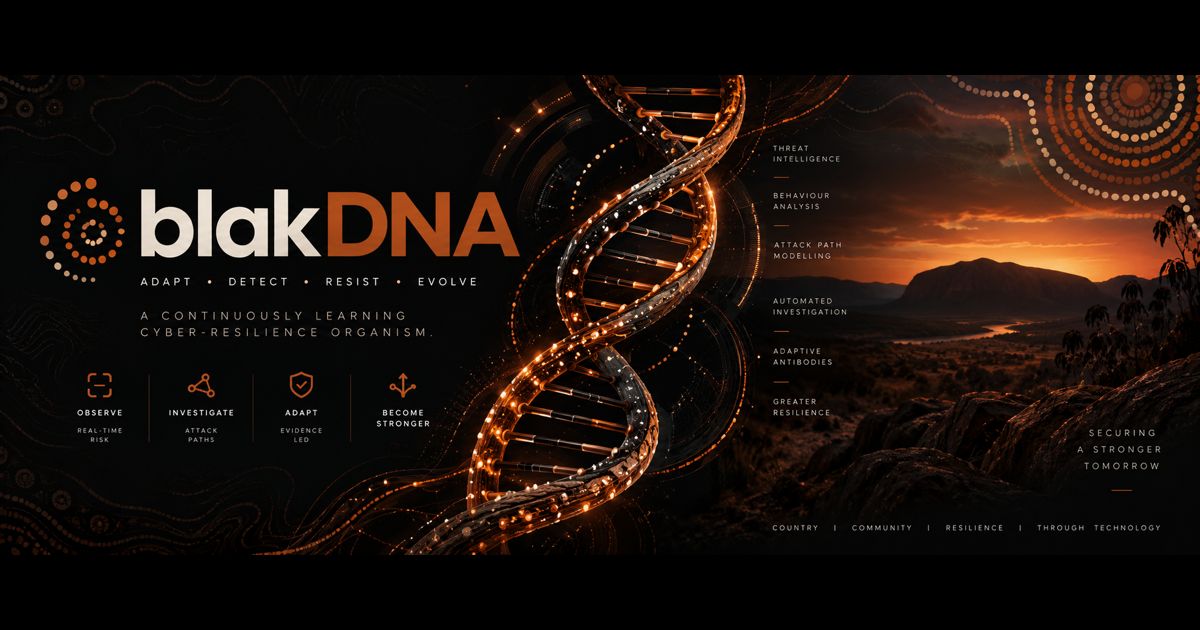
blakDNA is not a SIEM, CSPM, scanner, GRC platform, SOC dashboard, or chatbot. It connects their signals to your organisation's evolving context.
Meet the organismThe Security Genome
Assets, identities, privileges, controls, and decisions form a connected picture of what matters and what an attacker could reach.
A deployment role gains IAM policy-management rights. The change matters because of the route it may open.
Synthetic demonstration. Reachability depends on policy scope, trust, and effective controls.
Understand the pathNormalize observations. Preserve evidence. Understand what changed in the genome.
Retrieve relevant memory. Test a hypothesis. Challenge the apparent attack path.
Call out material risk. Capture a human's reason, not just a button press.
Observe the fix independently. Retain the outcome. Evaluate adaptive antibodies.
A hard boundary
Learning your organisation's habits must never erase security knowledge. A common weakness is still a weakness.
Read the safety modelScoped reasoning and specialist delegation, supported by deterministic engineering and persistent cyber-specific memory.
No. blakDNA maintains a temporal organisation model and persistent cyber memory. It works with security data sources rather than replacing them with a chat interface or another log store.
No. Normal and secure remain separate judgements. Repeated unsafe behaviour remains unsafe, even when it is common in the organisation.
Consequential remediation requires explicit human approval by default. Investigation, recommendations, and verification do not authorize changing IAM, disabling accounts, or deleting infrastructure.
The customer-hosted architecture keeps the application and authoritative PostgreSQL data in the buyer's AWS environment. Hermes receives scoped evidence context through approved interfaces, not unrestricted raw telemetry.